Conjunctivitis: What To Know

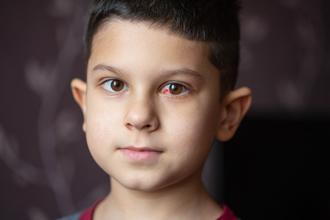
Conjunctivitis, more commonly known as pink eye, is often a communicable eye infection that can spread from person to person.

What causes pinkeye?

In most cases, an infection is to blame, resulting from a sinus or ear infection. Some viruses or bacteria lead to contagious forms, while others develop from allergies or exposure to irritants.

What happens if my baby has pinkeye?

If your newborn develops pinkeye, seek pediatric care right away, as this condition can lead to severe complications if left untreated, usually requiring antibiotic eye drops.

How do I know that it’s pinkeye?

Signs include a gritty feeling, thick gooey discharge, sensitivity to light, swelling, itching, and eye pain.

How is pink eye treated in kids?

Most viral pinkeye goes away without treatment once the body fights the virus, but bacterial infections need antibiotic eye drops. Recurring bouts could indicate allergic conjunctivitis, which your pediatrician can treat with allergy medications.

Tips to Help Your Child Eat Healthier

If you’re having trouble making smart nutritional choices for your kids, your child’s pediatrician can help you create healthier eating habits.

Choose Smarter Snacks — Instead of candy or chips, try nuts, apple slices with peanut butter, whole-grain crackers and cheese sticks, or hummus and carrots.

Get Your Kids Cooking — Making children an active part of meal preparation gives them pride in the foods they’ve helped make, leading to them being more likely to eat it.

Hide Healthier Foods — Hide veggies into dishes they already love such as whole grain mac and cheese, soups, or sandwiches.

Show Your Kids How It’s Done — Kids watch and mimic what parents do, so leading by example can improve not just your child’s health but yours as well.

The Importance Of Preventive Care

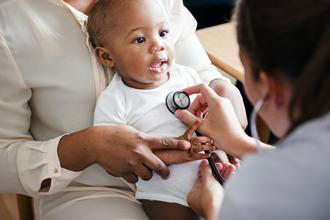
Regular wellness visits with your pediatrician allow your child’s doctor to continue monitoring their health and development throughout childhood and teen years.

What is a wellness visit?

A well-child visit typically involves recording height and weight, providing detailed medical history, checking vital signs, hearing and vision screenings, a full physical examination, additional testing if necessary, and vaccinations as needed.

Once your baby is born, they will come in regularly for wellness visits, nearly every month until they are three years old.

Why are wellness visits so important?

These checkups are the best way to prevent health problems from happening in the first place, providing parents with support and advice, catching problems early when they can be more easily managed, and building a trusted relationship with a doctor for your family.

Child Behavior Problems

All kids are going to act up, throw tantrums and be irritable at times; however, if your child is displaying negative actions regularly, you may wonder if there is something more going on.

Is This Normal Behavior?

Common behavior issues include being defiant, lying, whining, impulsivity, issues around bedtime or food, anger, and temper tantrums. You may want to seek professional help if these behaviors continue regardless of discipline, affect schoolwork or social interactions, or aren’t appropriate for their age.

Behaviors that are not normal and should be a cause for concern include aggressive or violent behavior, harm to self or others, hearing or seeing things that aren’t there, breaking rules or skipping school, sudden extreme behavioral changes, or showing no remorse.

How can a pediatrician help?

If your pediatrician believes a developmental, neurological, or mental health disorder could be to blame, they may recommend additional testing and evaluations, then create a custom treatment plan and refer your child to therapists or other specialists as needed.

Make Sure Your Child Gets Their Regular Check-Ups

To ensure that your child grows up healthy and strong, they need to see a pediatrician for regular check-ups, screenings, and vaccines. These well-child visits are incredibly important for your child’s health and wellbeing and begin within the first week after your child is born. Since your child will be visiting a pediatrician regularly, you must find one that fits your family’s needs. Even before your baby is born you should shop around for a pediatrician so that once your baby comes into the world you can start giving them the routine check-ups and care they need for a healthy and long life.

Getting Regular Check-ups

These routine check-ups with the pediatrician are incredibly important for your child’s health and development. Within the first few years of life, your child’s development is rapid and these check-ups allow our pediatrician to spot problems or developmental delays early. These check-ups are also focused on preventive care, which means providing your child with vaccines and screenings early on to prevent health problems in the future.

These check-ups are also important for parents, as it gives them a chance to ask questions they may have about their child’s sleeping and eating habits, or other behaviors their child may be displaying. During your child’s regular pediatric checkups, your doctor will check your child’s height, weight, vision, and hearing. These visits begin within the first five days after birth and will continue at:

  • 1 month old
  • 2 months old
  • 4 months old
  • 6 months old
  • 9 months old
  • 12 months old
  • 15 months old
  • 18 months old
  • 24 months old
  • 30 months old
  • 3 years old

Once your child turns 3 years old, they may only need to visit their pediatrician once a year for a check-up. Of course, children dealing with certain health issues may still need to come in more often for care.

Getting Vaccinated

Vaccines are also an important part of these visits, and immunizations are truly one of the best and most effective ways to keep your child healthy and free from potentially dangerous diseases such as measles, polio, and hepatitis B. Your pediatrician can provide your child with all the vaccinations they need, particularly before starting school.

Looking for a pediatrician? Need to schedule your child’s next check-ups? Our pediatric team is here to address any questions and concerns you may have. From immunizations to sports injuries, we handle it all.

Seeking Help for Your Child’s Sports Injuries

Regular physical activity is so important for your child’s health. If they have decided to start playing on a sports team this can also be a great way for them to build confidence and socialize. Of course, pediatricians also understand just how important it is to keep your little athlete healthy both on and off the field. If your child does sustain an injury your pediatrician may be the first person to help, so it’s important to find a pediatrician that you and your family trust.

Preventing Injuries

The goal is always to help your child prevent sports injuries and your pediatrician can become an integral part of providing the preventive care your child needs to stay healthy. This starts with an annual sports physical, in which your child will receive a comprehensive physical exam from a qualified pediatrician to make sure that they are healthy enough for their chosen sport. Your pediatrician can also look at your child’s lifestyle to determine if any changes need to be made to their training routine, eating habits, or sleep to improve performance and reduce the risk for injury.

A pediatrician is an integral part of keeping your child healthy and safe while participating in sports. They can answer your questions and address any concerns you may have, as well as recommend certain conditioning and training exercises that can help with injury prevention. Your child should also be wearing the appropriate protective gear including a helmet when playing sports.

Treating Sports Injuries

Sometimes, despite taking all the necessary precautions, your child still sustains a sports injury. The moment your child sustains an injury they need to stop playing immediately and avoid any physical activity until the injury has fully healed. The most common sports injuries in kids are minor strains and sprains which can be treated at home through the RICE method (rest, ice, compression, and elevation). However, if pain persists or gets worse, it’s important to see your child’s pediatrician.

Your child should visit a pediatrician right away if you suspect that they have a broken bone, dislocation, concussion, or if they are dealing with severe pain or swelling. If your child is unable to walk or put weight on the affected leg, this is also a sign to see a pediatrician as soon as possible. The sooner sports injuries are addressed and properly treated the better.

How To Brush Your Child’s Teeth

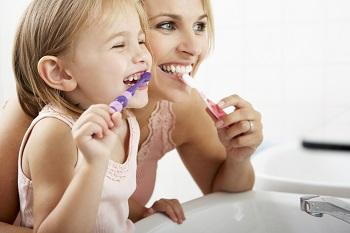
So, your child’s teeth just started to come in. We know that this can be an exciting milestone for parents. Of course, this also means considering your child’s oral health. Just as you brush and floss your teeth every day, you will now need to begin brushing your child’s teeth. While the techniques and practices will be a bit different and probably less time-consuming (seeing as your child probably only has one or two teeth at the moment), here are some tips for how to brush your child’s teeth properly,

  • Even before your child’s teeth start to erupt it’s important to keep their gums healthy and clean by wiping them with a soft, damp cloth after each feeding and right before bedtime. Your child will get their first tooth between 6-14 months.
  • Yes, even children’s teeth can develop decay. As soon as the tooth is formed it can develop decay, so it’s important that you start brushing it as soon as you see it.
  • Purchase a child-sized toothbrush from your local drugstore and wet the soft-bristled toothbrush with water to brush your child’s tooth or teeth (at this point you don’t need toothpaste).
  • Your child won’t start needing toothpaste until they are 2 years old. From 2-3 years old your child only needs toothpaste the size of a grain of rice in order to clean their teeth. After 3 years old, you can upgrade to a pea-sized amount of toothpaste.
  • Just as you do for your own teeth, you should also brush your child’s teeth twice a day (once in the morning and again at night right before going to bed).
  • Use soft, circular motions when brushing the teeth and the gums. Again, just as you do your own teeth, you should brush for a minimum of two minutes. Don’t forget to brush their tongue and roof of their mouth, too.
  • We know that your child may not fully understand the brushing process, so it’s a good idea to tell them what you are doing and the importance of brushing their teeth. Even though they can’t brush their own teeth yet it’s still great to show them how to brush so that when it’s time to start brushing their own teeth they understand how to do it.
  • Most children can start brushing their teeth around 7-8 years old, but still need to be supervised by an adult until around 10-11 years old.

Have questions about caring for your baby’s developing smile? Keeping your child’s smile healthy is so important for their development and practicing good oral hygiene at home will ensure that your child’s smile stays healthy.

When To Get A Vision Test For Your Child

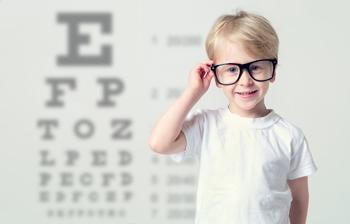
Parents want nothing more than their children to be healthy and happy. This applies to every element of their well-being, including their eyes! Your pediatrician recommends that all children receive a comprehensive eye exam by the age of one. These tests detect any problems that require correction. Prolonging an exam can damage your child’s eyes for life. 

When Should My Child’s Vision Be Tested?

Your child should have had several tests done by the age of five. This confirms for your pediatrician that they are developing normally. Follow this recommended time-table: 

  • At birth: this is performed right away on your child, as part of the newborn physical assessment.
  • 6 months: your pediatrician evaluates your child’s eyes at their regular appointment. 
  • 3.5 years old: at your child’s appointment, the pediatrician tests their eyes and also their visual acuity. 
  • 5 years old: a standard assessment performed at a pediatric appointment. 

After this, eye screenings are implemented at your discretion. Your pediatrician will check your child’s eyes at their annual checkup. If your child fails an eye exam, you need to schedule a full pediatric eye evaluation right away. 

Another reason you should get your child’s eyes checked is if you have a family history of eye conditions. This is especially true if you have other children that have vision problems.

Why Does My Child Need an Eye Exam If They Passed the Vision Screening?

There are certain circumstances where your pediatrician refers your child for a full eye examination. This is common for infants that show signs of a lazy eye or crossed eyes. Other possible red flags in infants are problems tracking objects or a strangely colored pupil. 

Is your child struggling in school? Don’t jump to conclusions without an eye examination from your pediatrician. If a child can’t see the board or follow along with lessons, their performance will suffer. Corrective eyewear and other treatment options can help. Eye examinations are even more important for children with learning disabilities. Eye problems can make coping with a learning disorder much harder. 

What to Expect at Your Child’s Eye Examination

Your child has nothing to be worried about at their appointment. There is nothing scary or painful! The pediatrician will ask you about your family history, especially anything related to eye health. From there, they check your child’s pupil and muscle function, along with sharpness.

In certain cases, your pediatrician will dilate the eyes. This is performed by placing special drops in the eyes. After about forty minutes, the pediatrician can examine the major structures. 

Signs That Your Child May Have Autism

Autism Spectrum Disorder (ASD) is a developmental condition that affects how a person views and interacts with the world around them, including other people. In most cases, differences become apparent by the time your child reaches 24 months. Mainly, parents notice behavioral differences and language delays. If you suspect that your child has ASD, schedule an appointment with your local pediatric office. We work with you to figure out what to do next.

Signs of ASD 

Every child with ASD is different. Not everyone will have the same symptoms or experiences. With that in mind, here are some summaries on social, communication, and behavioral differences. 

Social Differences

  • Your child doesn’t keep or make eye contact
  • They don’t respond to your facial expressions or smiles
  • Does not reciprocate facial expressions or have the appropriate ones
  • Doesn’t respond to parent’s pointing 
  • Has problems making friends
  • Shows a lack of concern for others

Communication Differences

  • Your child hasn’t spoken by 16 months
  • Repeats or parrots what others say
  • Doesn’t feel the need or want to communicate 
  • Starts missing language and social milestones after 15 months
  • Doesn’t pretend play but does have a good memory for numbers, songs, and letters

Behavioral Differences

  • Has an affinity for routines and schedules and does not like altering them
  • Likes to twirl their fingers, sway, rock, or spin
  • Has strange activities that they enjoy doing repeatedly
  • They are sensitive to sounds, lights, touch, textures, and smells
  • They are more interested in the parts of a toy instead of the whole thing

Common Examples

Don’t feel overwhelmed by the information listed above. As mentioned, a child can have a mixture of any of these behaviors. There are a few other common examples that your pediatrician sees. These give you insight into how a neurotypical child reacts in certain situations versus a child with ASD.  

By the age of 12 months, your child should turn their head when they hear their name. A child with ASD won’t respond even if their name is called multiple times.

By 18 months, a child with speech delays finds accommodations through gestures, facial expressions, or pointing. Children with ASD find no reason to compensate for speech. 

After 24 months, many children enjoy bringing their parents objects or toys to look at or play with. A child with ASD may bring their parent an object but will not play with their parent or respond to their reaction.

Signs of Tonsillitis

Everyone is born with two tonsils. These are lymph nodes located right in the back of the throat. They help out the immune system by housing important white blood cells. Even so, the tonsils themselves can become infected, which is known as tonsillitis. The tonsils swell up, causing pain and discomfort. Children between the ages of five and eleven experience it the most. You need to bring your child in to see a pediatrician right away. Tonsillitis is commonly caused by streptococcus pyogenes also known as strep throat. 

The Basics of Tonsillitis

Your tonsils work by trapping dangerous viruses and bacteria within. As mentioned before, this can lead them to become infected. Infections are easily transferred between children, with tonsillitis being caused by strep, adenovirus, the flu, and Epstein-Barr virus (mono).

Your pediatrician is highly qualified in treating tonsillitis. That is because almost all cases are found in children. During puberty, the tonsils shrink in size. This makes it much harder for them to become infected. You need to seek medical intervention right away. Infections can become life-threatening if not treated, leading to diseases like rheumatic fever. An even more serious complication is a peritonsillar abscess. The infection spreads beyond the tonsils and swells up the neck and chest tissues. This can block and stop your child’s airways. 

Signs of Tonsillitis in Children

In children under the age of two that have problems communicating what is wrong, symptoms manifest in the form of excessive drooling, refusing food or bottles, and fussiness. Expect these symptoms in older children: 

  • Sore throat
  • Noticeably bigger tonsils
  • Fever
  • Pain or problems with swallowing
  • Yellow or white patches coating the throat and tonsils
  • Swollen lymph nodes in the neck
  • Foul breath
  • Stiff neck
  • Headaches
  • A scratchy or rough voice
  • Stomach pain

Diagnosing Tonsillitis

Your pediatrician won’t have any trouble diagnosing your child with tonsillitis. They will first start by asking for a brief history of when your child started feeling sick. The next step is performing a physical exam. The pediatrician will look in the throat, nose, and ears. If strep is suspected, a nurse takes a swab of the throat. A blood test will also be drawn to identify what bacteria or virus is responsible.

If strep or another bacteria is responsible for your child’s tonsillitis, antibiotics are prescribed. It’s important that your child finishes the whole dose. This guarantees that the entire infection is gone.